In high-volume confectionery and bakery production, efficiency is not optional—it is fundamental. A coating that takes too long to set, requires constant temperature correction, or produces inconsistent gloss can slow entire production lines. For manufacturers operating enrobing tunnels and automated coating systems, even small process disruptions can translate into significant output losses. This is where Non-Tempering Chocolate (Compound Chocolate): Efficient Solution for Industrial Coating & Enrobing becomes highly relevant.
Unlike traditional chocolate that depends on cocoa butter crystallization, non-tempering chocolate—also known as compound chocolate—offers operational simplicity, faster processing, and stable performance in demanding industrial environments. For businesses focused on throughput, consistency, and cost control, understanding the technical advantages of compound chocolate can directly influence profitability and product stability.
This article examines how non-tempering chocolate works, why it is suited for industrial coating and enrobing, and what manufacturers should evaluate before integrating it into their production systems.
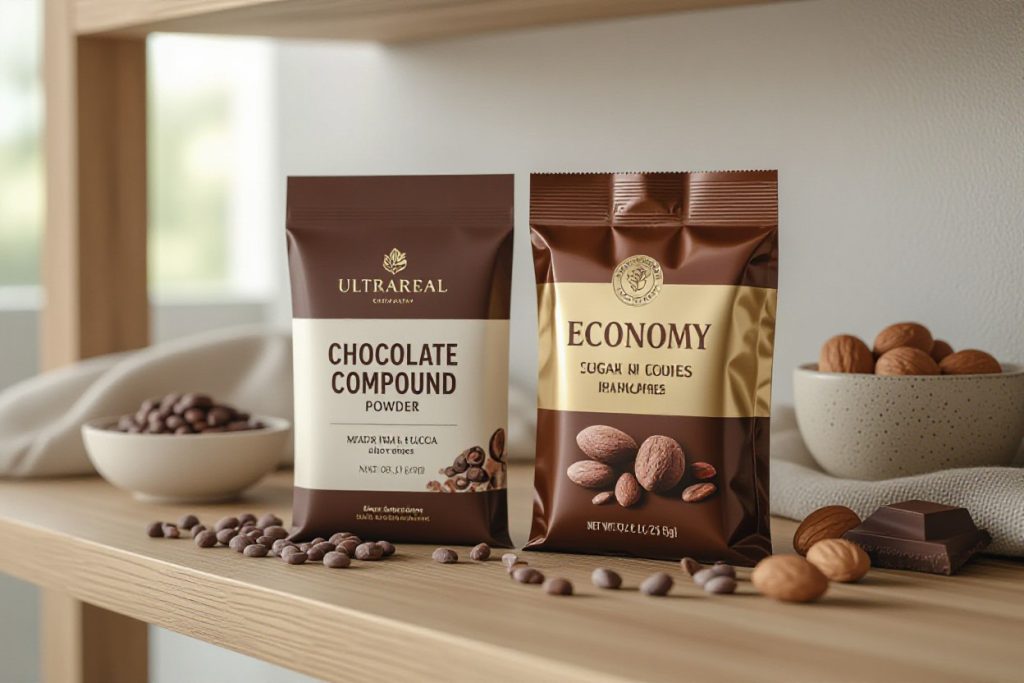
Understanding Non-Tempering Chocolate (Compound Chocolate) in Industrial Production
To appreciate why Non-Tempering Chocolate (Compound Chocolate): Efficient Solution for Industrial Coating & Enrobing has gained widespread industrial adoption, it is important to understand its structural composition.
What Makes Chocolate “Non-Tempering”?
Traditional chocolate contains cocoa butter as its primary fat component. Cocoa butter requires tempering—a controlled heating and cooling process—to form stable crystals. Without proper tempering, the finished product may exhibit fat bloom, dull appearance, or soft texture.
Non-tempering chocolate replaces cocoa butter partially or entirely with vegetable fats such as palm kernel oil or other specialty fats. These fats do not require the same crystallization management. As a result, compound chocolate can be:
Melted directly
Applied to products
Cooled without complex temperature curves
This simplifies production significantly.
Core Composition of Compound Chocolate
A typical non-tempering chocolate formulation includes:
Cocoa powder
Sugar
Vegetable fat
Emulsifiers
Flavor components
Because vegetable fats have different melting profiles compared to cocoa butter, compound chocolate behaves differently during application and cooling. These characteristics are not inferior; rather, they are optimized for specific industrial objectives—particularly coating and enrobing.
Why Industrial Manufacturers Prefer It
Industrial environments prioritize:
Speed
Predictability
Reduced technical complexity
Lower production risk
Non-tempering chocolate aligns with these operational priorities, making it a practical solution for factories managing continuous production lines.
Why Non-Tempering Chocolate Is Ideal for Industrial Coating & Enrobing
When evaluating Non-Tempering Chocolate (Compound Chocolate): Efficient Solution for Industrial Coating & Enrobing, coating performance becomes the central focus.
Faster Setting Time
In industrial enrobing systems, products such as biscuits, wafers, snack bars, and cakes pass through chocolate curtains before entering cooling tunnels. The speed at which the coating solidifies directly affects line capacity.
Compound chocolate typically sets faster than tempered chocolate under comparable cooling conditions. This enables:
Shorter cooling tunnels
Increased line speed
Reduced energy consumption
Faster crystallization translates to higher output efficiency.
Reduced Equipment Dependency
Traditional chocolate coating requires:
Continuous tempering machines
Strict temperature monitoring
Skilled operators
Non-tempering chocolate reduces reliance on tempering units. Melting tanks and standard temperature control systems are generally sufficient. This lowers maintenance requirements and simplifies staff training.
Stable Coating Thickness
Uniform viscosity is essential for consistent coating thickness. Compound chocolate formulations can be engineered for specific viscosity ranges, allowing controlled enrobing coverage and minimal dripping.
This is particularly valuable in:
Biscuit coating
Donut dipping
Snack bar enrobing
Confectionery shell formation
In these applications, surface consistency affects both appearance and packaging performance.
Operational Efficiency and Cost Optimization in Large-Scale Production
Efficiency gains are a major reason why Non-Tempering Chocolate (Compound Chocolate): Efficient Solution for Industrial Coating & Enrobing remains widely adopted in commercial food manufacturing.
Lower Raw Material Volatility
Cocoa butter prices fluctuate based on global supply dynamics. Because compound chocolate uses vegetable fats instead of cocoa butter, it offers more predictable raw material costs.
For manufacturers producing large volumes, price stability simplifies budgeting and contract pricing.
Reduced Waste and Rework
Improper tempering can result in:
Bloomed surfaces
Soft coatings
Batch rejection
Non-tempering chocolate minimizes these risks. Without the need to control cocoa butter crystal formation, operators face fewer quality deviations related to temperature shifts.
Reduced rework means:
Lower material waste
Less downtime
More consistent yield
Energy Efficiency
Tempering machines consume energy to maintain precise heating and cooling cycles. Eliminating tempering reduces energy demand and simplifies thermal management across the production line.
For factories aiming to optimize operational expenditure and sustainability metrics, this difference is significant.
Global cocoa production and market dynamics, as monitored by the International Cocoa Organization (ICCO), influence cocoa butter availability and pricing—factors that often drive manufacturers to consider compound chocolate solutions for industrial applications.
Performance Characteristics in Industrial Applications
Beyond efficiency, Non-Tempering Chocolate (Compound Chocolate): Efficient Solution for Industrial Coating & Enrobing must deliver reliable product performance.
Heat Resistance and Storage Stability
Compound chocolate can offer better resistance to moderate temperature fluctuations compared to improperly tempered chocolate. This is advantageous in distribution environments where strict climate control may not always be guaranteed.
For products shipped across regions with varying climates, stable coating performance reduces the risk of visible defects.
Gloss and Surface Finish
While tempered chocolate is known for its glossy finish, modern compound chocolate formulations can achieve visually appealing surfaces suitable for mass-market products.
In industrial bakery segments, visual consistency and structural integrity often outweigh artisan-level gloss requirements.
Structural Strength
In enrobing applications, coatings must:
Resist cracking during packaging
Withstand mechanical handling
Maintain adhesion to substrates
Compound chocolate can be engineered with specific fat blends to enhance structural resilience.
Application Examples Across Industrial Segments
The practicality of Non-Tempering Chocolate (Compound Chocolate): Efficient Solution for Industrial Coating & Enrobing becomes clear when examining real-world applications.
Biscuit and Wafer Coating
Biscuits require coatings that adhere well and set quickly to maintain shape. Compound chocolate performs reliably in curtain enrobing systems without tempering interruptions.
Snack Bar Production
Cereal bars and protein bars benefit from stable coating that does not soften excessively at room temperature. Compound chocolate supports continuous bar production at high speed.
Donut and Cake Dipping
In bakery environments, dipping lines must operate efficiently during peak production hours. Non-tempering chocolate simplifies workflow by eliminating tempering adjustments between batches.
Decorative Drizzles and Bottom Coatings
Many industrial products use chocolate primarily for texture contrast and aesthetic appeal. In such cases, compound chocolate delivers consistent performance without premium cocoa butter requirements.
Manufacturers evaluating cocoa-based solutions for coating systems can review available specifications and industrial-grade formulations through CocoaNusa’s official platform at https://cocoanusa.com/, which provides insight into compound chocolate and related cocoa ingredients for B2B markets.
Strategic Considerations Before Choosing Non-Tempering Chocolate
Although Non-Tempering Chocolate (Compound Chocolate): Efficient Solution for Industrial Coating & Enrobing offers clear operational advantages, manufacturers should evaluate specific production goals before implementation.
Product Positioning
Premium confectionery brands emphasizing traditional chocolate craftsmanship may prefer cocoa butter-based formulations. For industrial, value-oriented products, compound chocolate often aligns better with cost and efficiency objectives.
Regulatory Compliance
In some markets, labeling regulations distinguish between chocolate and compound-based products. Manufacturers must ensure accurate naming and ingredient disclosure according to local food laws.
Sensory Expectations
Compound chocolate delivers satisfying flavor when formulated with high-quality cocoa powder. However, cocoa butter-based chocolate may provide a more pronounced melt-in-mouth sensation.
Balancing performance, cost, and sensory objectives is critical for long-term success.
Why Non-Tempering Chocolate Remains a Practical Industrial Choice
For large-scale manufacturers, ingredient decisions influence not only taste but also operational stability. Non-Tempering Chocolate (Compound Chocolate): Efficient Solution for Industrial Coating & Enrobing continues to serve as a dependable solution for factories prioritizing throughput, cost control, and consistent output.
By eliminating the tempering stage, production lines become simpler and more predictable. Faster setting times enhance efficiency, while stable viscosity supports uniform coating thickness. When formulated responsibly and used appropriately, compound chocolate provides a balance between technical performance and commercial practicality.
In competitive industrial food markets, efficiency and reliability are often decisive advantages. Manufacturers seeking to optimize coating systems and enrobing performance should evaluate compound chocolate formulations in alignment with their production objectives and market positioning.