Table of Contents
- Next-Gen Tempering Machines
- Advanced Enrobers and Moulding Lines
- 3D Printing and Customization
- Automation and Robotics
- Energy Efficiency and Continuous Processes
- Advances in Chocolate Grinding Technology
- Innovations in Packaging Machinery
- Temperature and Humidity Control Systems
- Data Integration and Smart Factory Concepts
- User-Friendly Design for Operators
- Regulatory Compliance and Food Safety
- Future Trends in Chocolate Machinery
- Case Studies of Success
- Conclusion
With rapid innovations reshaping production, you will find chocolate manufacturing machinery evolving from 3D printing prototypes to AI-driven lines that boost efficiency and consistency. Modern chocolate manufacturing machinery integrates robotics, sensors, and predictive analytics so your operations scale with precision, and your partners can source chocolate manufacturing machinery with modular designs. Upgrading chocolate manufacturing machinery reduces waste, speeds design-to-market cycles, and enhances product variety. Forward-looking teams choose chocolate manufacturing machinery that supports traceability, customization, and intelligent maintenance to stay competitive.
Next-Gen Tempering Machines
Modern tempering machines shrink footprints and boost yield, letting you run higher-capacity lines with lower energy and simpler sanitation. New designs cut tempering time by up to 30% and integrate with existing chocolate manufacturing machinery to deliver consistent beta-V crystal formation across batches. Manufacturers report throughput gains from 500 to 2,000 kg/hr on compact continuous temperers, and you can tailor settings per formula for milk, dark or white varieties.
Improvements in Tempering Technology
You now get ±0.1°C control via combined PID and model-predictive algorithms, enabling target temperatures (dark 31–32°C, milk 29–30°C, white 28–29°C) on chocolate manufacturing machinery. Inline NIR and viscosity sensors provide real-time crystal feedback, so you cut rejects and shorten cycle times. Several plants using updated vacuum-assisted temperers reported a 20% reduction in bloom complaints within six months.
Continuous Tempering Machines
Continuous temperers deliver steady-state control, letting you run uninterrupted production at 100–2,000 kg/hr depending on model and recipe, which keeps your chocolate manufacturing machinery consistent across shifts. You benefit from reduced shear and uniform crystal seeding through scraped-surface exchangers and staged cooling phases. Aasted and Bühler-style designs are common in medium-to-large plants, often integrating directly with enrobing and molding lines.
Heat-transfer efficiency in continuous tempering comes from spiral or scraped-surface barrels and controlled residence times of 1–10 minutes, so you can stabilize crystal growth while maintaining throughput on chocolate manufacturing machinery. Inline viscosity control and automated seed dosing let operators reduce manual adjustments, and some plants have reported up to 18% energy savings versus batch tempering when retrofitting continuous units into existing lines.
Smart Features and AI Integration
You now see AI optimizing tempering curves through machine learning models that analyze NIR, torque and temperature streams, enabling adaptive setpoints on chocolate manufacturing machinery. Predictive maintenance flags bearing wear and motor anomalies before downtime, and closed-loop control can reduce variability by 30% in pilot lines. Vendors increasingly offer cloud dashboards and OPC UA connectivity so you can monitor KPIs across plants.
Machine-learning models trained on process and sensory data let you classify crystallization states and auto-tune seed dosing; a confectioner piloting such a system saw a 25% drop in rejects over three months. Integration with PLCs, MQTT and cloud analytics also enables remote recipe updates and batch traceability, helping your chocolate manufacturing machinery meet tighter quality specs while reducing operator intervention.
Advanced Enrobers and Moulding Lines
You can achieve far tighter tolerances and higher throughput when modern chocolate manufacturing machinery integrates servo-controlled enrobers and modular moulding lines; these systems typically cut coating waste by 10–20% and boost line speeds to 2,000–5,000 pieces/hour depending on cavity count. Operators use closed-loop feedback, thermal zoning and vision inspection to hit target weights and finish, and you can read about digital upgrades in the sector at The Digitalization of Chocolate Manufacturing | News & Insights.
- High-precision enrobers with ±0.1 mm coating control for consistent gloss and mouthfeel
- Integrated depositor-to-mould synchronization to eliminate misfeeds and reduce rejects
- Automated demoulding and belt segmentation to support multi-shape production runs
- Inline weight-checkers, metal detectors and vision systems for 100% quality verification
Key features vs. impact
| Feature | Impact |
|---|---|
| Precision thickness control (±0.1 mm) | Lower coating use and consistent weight compliance |
| Servo-driven depositor integration | Faster changeovers and synchronized mould fills |
| Quick-release moulds and CI P-friendly surfaces | Shorter sanitation cycles and less downtime |
Precision Thickness Control in Enrobing
You’ll find modern enrobers use servo pumps, laser or camera-based gap sensing and closed-loop feedback to maintain coating thickness within ±0.1 mm, which trims chocolate manufacturing machinery variability and saves material. Many processors report 10–15% lower coating consumption after retrofitting PID control and real-time weight feedback, and you can tune spray nozzles per SKU for repeatable gloss and snap.
Innovations in Moulding Techniques
You should expect moulding lines now to combine 3D-printed prototype tooling with stainless-steel production moulds, enabling rapid SKU launches and multi-cavity arrays (20–60 cavities) that push hourly outputs to several thousand pieces; this evolution in chocolate manufacturing machinery shortens time-to-market and raises design fidelity.
Going deeper, you’ll see twin-shot and insert-moulding paired with vacuum-assisted filling to eliminate air pockets in delicate centres, while micro-texturing on mould surfaces produces branded finishes without secondary polishing. Manufacturers deploy modular cavity plates so you can swap formats in under 30 minutes, and automated tempering controls keep viscosity stable for consistent fill and release across long runs.
Cleaning and Maintenance Enhancements
You’ll benefit from CIP loops, hygienic quick-release belts and wash-down-rated enrober frames that let your team shorten sanitation cycles; many lines include smart sensors that log motor vibration and bearing temperature to schedule maintenance before failures occur, improving uptime on chocolate manufacturing machinery.
In practice, CIP-enabled enrobers can be flushed and sanitized in 20–35 minutes depending on geometry, and tool-less access points reduce manual labor for belt and nozzle swaps. Predictive maintenance platforms aggregate runtime, temperature and vibration data so you can replace parts during planned windows, cutting unplanned stoppages and preserving product quality.
3D Printing and Customization
You can leverage 3D printing to push chocolate manufacturing machinery beyond traditional limits, producing intricately latticed bonbons and multi-material shells that were previously impossible. Designers use sub-0.3 mm layer heights to achieve filigree details, and boutique brands pair printers with tempering machines to keep throughput steady. As a result, your R&D cycles shorten and your product line gains designs that stand out on-shelf and online while integrating into existing production lines.
The Rise of 3D Chocolate Printers
You’re seeing specialist vendors like Choc Edge and byFlow enable direct-deposition chocolate printers that extrude tempered chocolate at controlled temperatures, with typical resolutions of 0.1–0.3 mm. Operators report steady prints for single-origin couvertures and functional fillings, and pastry teams adopt printers for limited editions and detailed toppers. Integration into chocolate manufacturing machinery workflows is increasingly straightforward, letting you move prototypes into pilot production without rebuilding the line.
Rapid Prototyping for Custom Moulds
You can turn concepts into functional moulds in 24–72 hours by 3D printing masters for silicone casting, slashing lead times that once took 2–6 weeks. Rapid prototyping lets you test cavity geometries, undercuts, and multi-part assemblies before committing to CNC aluminium tooling, reducing trial runs and waste in your chocolate manufacturing machinery setups.
You should note material and post-processing choices: stereolithography (SLA) gives fine detail for masters, FDM prints are useful for coarse forms, and food-safe silicone copies require proper surface finishing or FDA-compliant coatings. In practice, a mid-sized chocolatier moved from biweekly seasonal launches to weekly iterations by printing masters and casting silicone in-house, accelerating product validation while keeping production compatible with existing chocolate manufacturing machinery.
Mass Customization Opportunities
You’ll find mass customization achievable by combining online configurators with in-line 3D printing, allowing personalized messages, logos, or shapes per order. Small-batch production becomes viable for weddings or corporate gifts, and retailers can offer customization kiosks that feed orders directly into your chocolate manufacturing machinery. This approach increases perceived value while preserving quality control through standardized printer recipes and tempering parameters.
You must plan for throughput and quality consistency: scaling often means deploying printer farms, automated depanning, and post-processing stations that tie back into tempering and enrobing lines. For example, configuring 10–20 synchronized printers with shared feeders and a central QC station can convert customization from an artisanal novelty into a predictable revenue stream, integrating smoothly with broader chocolate manufacturing machinery operations.
Automation and Robotics
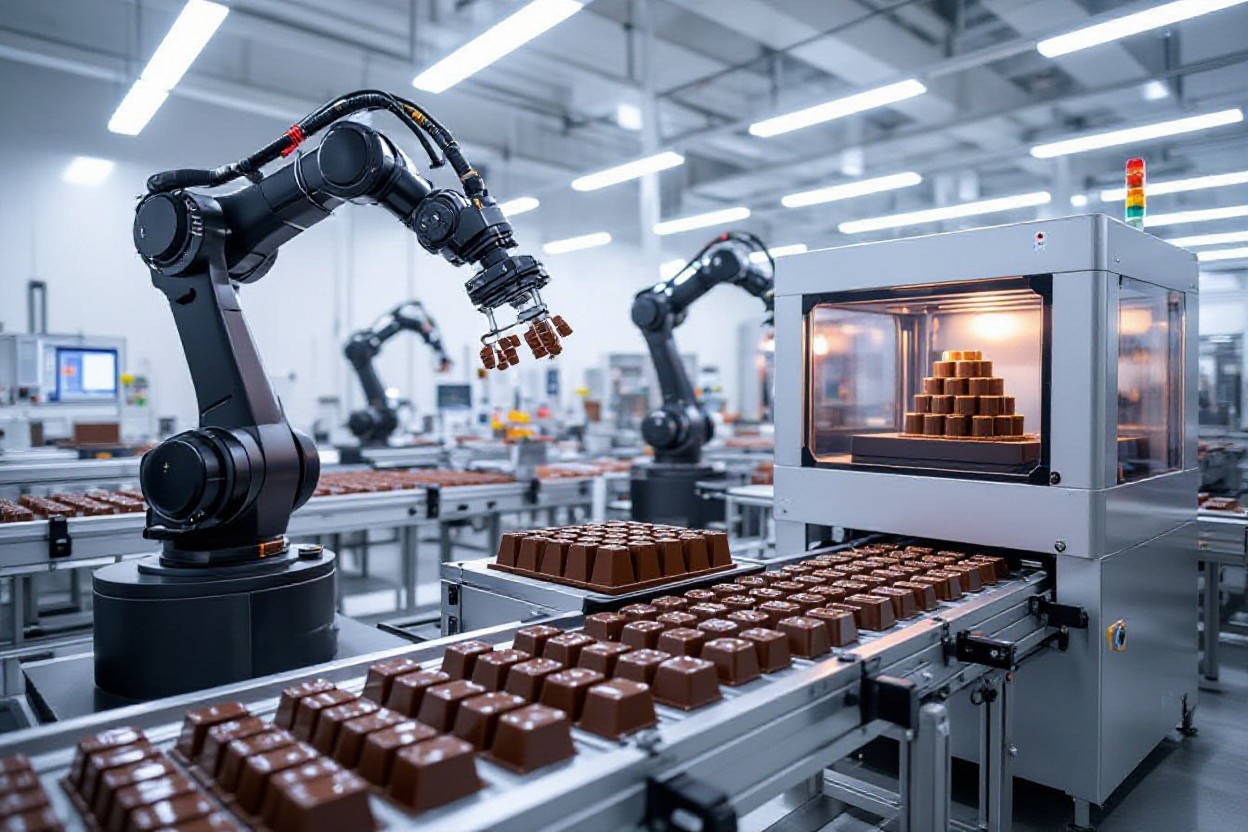
You see robotics and automation driving higher throughput on your lines, with chocolate manufacturing machinery integrating delta pick-and-place systems and articulated arms to hit 200–300 pieces per minute on enrobers and depositor chains. Modular conveyors, CIP-compatible stainless steel cells, and PLC-robot orchestration let you cut manual touchpoints by up to 80% while maintaining temper control and traceability in your chocolate manufacturing machinery deployment.
The Role of Robotics in Chocolate Production
For your production floor, collaborative robots handle delicate tasks like praline placement, glazing, and packaging with force sensing and tool changers; you can deploy six-axis robots for molding and delta robots for high-speed sorting. Specific systems reduce labor variance—robotic vision alignment increases yield by measurable percentages—and link directly to your MES so the chocolate manufacturing machinery adapts to SKU changes in minutes.
AI-Driven Quality Control Processes
You benefit from AI-powered vision and hyperspectral cameras that inspect surface gloss, bloom, and fill levels at line speeds, integrating with chocolate manufacturing machinery to reject defects at rates under 0.5%. Machine learning models trained on thousands of images enable you to detect micro-cracks and contamination that human inspection misses, improving first-pass yield and providing audit-ready traceability.
Deeper implementation uses convolutional neural networks deployed at the edge to analyze each bar in real time; you can combine 2D/3D imaging and infrared to quantify coating thickness to ±0.2 mm and classify defects into actionable categories. In one pilot, a mid-sized plant reduced false rejects by 45% after retraining models on its product variants, and you can feed that data back to a robotic depositor to self-correct dosing errors.
Predictive Maintenance for Machinery
You can deploy vibration, temperature, and current sensors on gearboxes, pumps, and tempering units to predict failures before they interrupt lines, with modern chocolate manufacturing machinery platforms offering cloud analytics and on-prem models. Condition-based alerts cut unplanned downtime by 30–50% in reported cases, and you receive prioritized work orders directly into your CMMS.
Going further, you should combine sensor streams with AI models that learn normal operating envelopes for each piece of equipment; anomalies trigger maintenance windows that you schedule during low-demand shifts. In practice, smart maintenance reduced spare-part inventory by 20% for some operators, while time-to-repair dropped thanks to fault diagnostics that tell your technicians which pump, bearing, or heater requires attention on the chocolate manufacturing machinery.
Energy Efficiency and Continuous Processes
You can slash operating costs by pairing energy-efficient drives, heat recovery and continuous lines; many chocolate manufacturing machinery upgrades deliver 20–35% lower energy use and 2–3x higher throughput, and you’ll see reduced batch variation as processes move from discrete batches to 24/7 continuous flow, letting your plant hit higher OEE while lowering kWh per tonne of finished product.
Energy-Efficient Chocolate Grinders
You should prioritize grinders with IE4 motors, variable-frequency drives and optimized gear trains; retrofits often cut grinder energy by 15–25% and improve particle-size consistency, and installing closed-loop vibration and temperature monitoring on your chocolate manufacturing machinery helps you avoid rework and maintain target D90 values without over-grinding.
Continuous Conching Techniques
You’ll find continuous conching replaces long batch runs with steady-state screw or rotor systems, reducing conching time from typical 20–48 hours to 2–8 hours in many operations, and this change on your chocolate manufacturing machinery can increase throughput while producing more consistent rheology and flavor profiles.
In practice, continuous conching uses twin-screw or single-screw conveyors with segmented heating and vacuum zones, and you can integrate inline viscosity, temperature and moisture sensors to control Maillard development; manufacturers report energy recovery via shell-and-tube exchangers and vacuum condensers recaptures up to 25–30% of process heat, while real-world pilots cut flavor variability by roughly half when you fine-tune residence time and shear profiles.
Sustainability Initiatives in Manufacturing
You should target water recycling, renewable electricity, and modular upgrades to existing chocolate manufacturing machinery; projects combining heat recovery, biomass boilers and LED lighting have driven CO2 reductions of 20–30% in several plants, and supplier-led retrofit programs let you modernize lines without full capital replacement.
Going further, you can deploy digital twins and energy-management systems to simulate equipment changes before spend, and pairing modular, recyclable components with supplier take-back schemes reduces waste streams; case studies show integrated approaches—renewables, heat recovery, and process optimization—can lower total scope 1 and 2 emissions by 25–40% while improving uptime on your chocolate manufacturing machinery.
Advances in Chocolate Grinding Technology
Refining now targets 15–25 µm particle sizes to sharpen mouthfeel, and you can see manufacturers trim grinding times by 20–30% through optimized roller gap control and temperature management. New seals, nitrogen cooling, and inline viscosity sensors let your chocolate manufacturing machinery stabilize batches faster. Several plants deploying closed-loop control report less than 0.5% batch-to-batch particle-size variance, proving chocolate manufacturing machinery improvements deliver measurable, repeatable gains.
Types of Modern Chocolate Grinders
You’ll encounter ball mills, roller refiners, bead mills, stone melangers, and vertical conches adapted for continuous or batch modes; each type alters shear profile, temperature rise, and throughput. Ball mills often reach finer grind (down to ~15 µm), while refiners run faster through successive rollers. Integrating these options into chocolate manufacturing machinery helps you match texture targets with production volume.
- Ball mills: high shear, ideal for fine particle size and small batches.
- Roller refiners: energy-efficient for large throughput and coarser targets.
- Bead mills: used when narrow particle distribution and low heat are required.
- Stone melangers: artisanal texture control with longer processing times.
- Perceiving modern chocolate manufacturing machinery as modular lets you swap grinders to optimize cost, quality, and flexibility.
| Ball mill | Target 15–25 µm; small-to-medium scale; suits low-temp builds using chocolate manufacturing machinery |
| Roller refiner | Typical 20–50 µm; high throughput; common in continuous chocolate manufacturing machinery lines |
| Bead mill | 15–30 µm with narrow distribution; used where minimal heat spike is needed |
| Stone melanger | 30–60 µm; artisanal profiles; slower, flavor-enhancing friction |
| Vertical conche | Final smoothing and flavor development stage integrated into chocolate manufacturing machinery workflows |
Consistency and Quality Enhancements
You can reduce variance by implementing inline particle-size analyzers and closed-loop speed/temperature control, producing stable batches within ±0.5 µm PSD targets. Automated sampling tied to your chocolate manufacturing machinery lets operators correct roller gaps or bead load in real time, shortening troubleshooting from hours to minutes and lowering scrap rates below 1% in many lines.
For deeper quality control, manufacturers are combining NIR spectroscopy, acoustic sensors, and machine-learning models to predict viscosity and mouthfeel from early grind-stage data. You benefit when predictive models flag drift before texture deviates, enabling preemptive adjustments to the chocolate manufacturing machinery and reducing rework; several mid-size producers report 15–25% fewer flavor inconsistencies after deploying such systems.
Integration with Other Processes
You should plan grinders as nodes in a digital plant: ERP-triggered recipes, automated CIP cycles, and synchronized tempering downstream minimize idle time. Conveyor metering and weighfeed controls let your chocolate manufacturing machinery maintain steady solids percentages, improving tempering consistency and packaging throughput up to 12% in optimized lines.
Beyond mechanical linkage, software integration matters: OPC-UA communication between grinders, conches, and temperers enables recipe recall and batch traceability. When you integrate maintenance logs and sensor telemetry, predictive maintenance schedules drop unplanned downtime; pilot installations show mean time between failures rising by 30% when the chocolate manufacturing machinery ecosystem is fully networked.
Innovations in Packaging Machinery
As packaging shifts toward higher speed and traceability, you see chocolate manufacturing machinery integrating inline vision, RFID, and MAP (modified atmosphere packaging) to extend shelf life by up to 30% on filled chocolates. Vendors report flow-wrappers reaching 180–240 bars per minute; integration with your ERP lets trace codes be assigned automatically. Major OEMs now offer retrofit kits to bring legacy lines into networked chocolate manufacturing machinery environments, cutting downtime and improving OEE.
Smart Packaging Solutions
Smart wrappers now embed NFC tags and QR codes so you can offer provenance and allergen data directly to consumers; chocolate manufacturing machinery vendors like Bosch and Hayssen integrate these systems with inline printers that handle 400 packs/min. You can also deploy camera-based inspection to verify print quality and detect seal defects at 0.5 mm tolerance, reducing recalls and enabling dynamic date coding across SKUs.
Eco-Friendly Packaging Developments
Biodegradable films, PLA coatings, and mono-material barriers let you cut mixed-material waste; using these, chocolate manufacturing machinery can handle cold-seal and heat-seal processes without adhesive layers, lowering recycling contamination by up to 40%. Several co-packers have replaced foil-plastic laminates with recyclable PE-only wraps, enabling curbside recycling while maintaining moisture barriers for pralines and enrobed bars.
To implement these changes, you can retrofit your chocolate manufacturing machinery with temperature-controlled seal jaws and shorter dwell times, preserving glossy finishes on tempered chocolate. In trials, switching to mono-polymer films reduced material thickness from 45 µm to 30 µm, saving roughly 33% material per pack and lowering film costs by 15–20% without changing shelf life when MAP was used.
Automation in Packing and Distribution
Robotic pick-and-place and automated case erecting let you scale seasonal runs quickly; you can equip your lines with delta robots that palletize at 1,200 cycles/hour and AGVs that route finished pallets using live inventory data. Integration of WMS with chocolate manufacturing machinery ensures first-expiry-first-out loading and reduces manual handling injuries by 60% in reported implementations.
When you tie AI-driven demand forecasting into packing, your chocolate manufacturing machinery can switch SKUs automatically, using tool-change systems that reconfigure magazine feeders in under 90 seconds. Case study: a mid-size confectioner reduced changeover losses by 28% and increased throughput 18% after deploying vision-guided robots and predictive maintenance modules.
Temperature and Humidity Control Systems
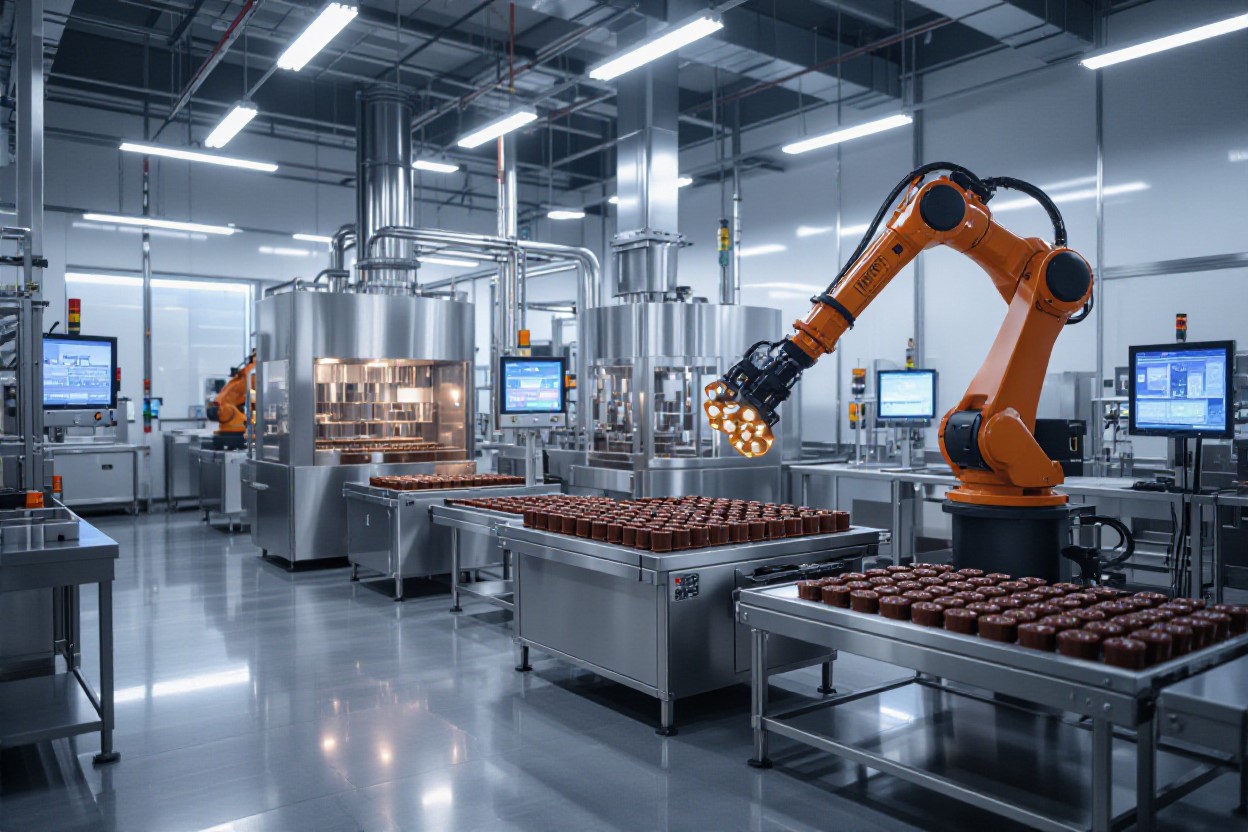
You rely on integrated HVAC, dehumidification and inline sensors to prevent bloom and stabilize temper profiles; modern chocolate manufacturing machinery links PLCs and SCADA so your process holds ±0.2°C and 45–55% RH, improving shelf life and yield. Read industry practice From bean to bar: innovation, industry 4.0, and the role of …
Key environmental controls
| Parameter | Control approach |
|---|---|
| Temperature | PID-controlled tempering baths, chilled glycol loops |
| Humidity | Desiccant/dehumidifier staging with RH sensors |
The Importance of Environmental Conditions
You monitor microclimates because shifts of ±1°C or ±5% RH alter viscosity, crystal growth and molding behaviour; chocolate manufacturing machinery with data logging and alarms helps you meet process windows (e.g., milk chocolate tempering at 31–32°C) and reduces rejects on high-speed lines.
Effects on product quality
| Issue | Impact |
|---|---|
| High RH | Sugar bloom, sticky surfaces |
| Temp swings | Bad crystal formation, texture loss |
Advanced Climate-Controlled Cooling Tunnels
You deploy multi-zone tunnels that sequence cooling, RH and airflow so molds cool uniformly; advanced chocolate manufacturing machinery uses VFD fans and chilled loops to cut cooling time by 30–50% while avoiding thermal shock and gloss loss.
- Zone-specific temp and RH setpoints for staged crystallization
- Adaptive airflow to prevent localized hot spots
- Inline sensors for product surface temperature and humidity
Cooling tunnel features
| Feature | Benefit |
|---|---|
| Multi-zone control | Consistent crystal formation |
| Rapid chill with controlled RH | Faster demolding, retained gloss |
You can specify tunnel length, zone count and temperature gradients to match product mass and mold geometry; typical designs use 3–7 zones with entrance temps near 18–20°C and exit temps down to 8–10°C, and chocolate manufacturing machinery coordinates conveyor speed and chill load to prevent condensation.
- Match zone times to cooling curves for each SKU
- Use surface temp probes for closed-loop speed control
- Integrate CIP-friendly drain and airflow paths
Design parameters
| Parameter | Typical ranges |
|---|---|
| Zones | 3–7 |
| Exit temp | 8–10°C for molded pieces |
Creating Optimal Conditions for Chocolate Production
You design plant airflow, airlocks and pressure differentials so ambient areas feeding lines stay at 18–22°C and RH near 50%±3, which lets chocolate manufacturing machinery run predictably and reduces hygiene and coating defects on enrobers and molds.
Facility controls
| Area | Target |
|---|---|
| Production halls | 18–22°C, RH 47–53% |
| Tempering rooms | ±0.5°C control |
You adopt environmental mapping, predictive HVAC scheduling and AI-driven setpoint adjustments to handle seasonal load shifts; integrating sensors across lines lets chocolate manufacturing machinery trigger maintenance alerts and auto-adjust ambient conditions to keep yield and product appearance stable.
Operational strategies
| Strategy | Outcome |
|---|---|
| Environmental mapping | Pinpoints hotspots and leakage |
| AI HVAC scheduling | Energy savings and steady RH |
Data Integration and Smart Factory Concepts
You can link MES, ERP, SCADA and PLC data to create a single control plane for chocolate manufacturing machinery, enabling real‑time quality checks and batch tracking. By combining edge computing with cloud analytics and digital twins, your line can detect deviations in seconds, reduce manual inspections, and shorten time‑to‑market for new mould designs. Integration lets you correlate sensor streams with recipe parameters for faster root‑cause analysis and smoother audits.
The Role of IoT in Chocolate Manufacturing
You deploy IoT sensors—temperature, viscosity, humidity and motor current—directly on chocolate manufacturing machinery to capture process signals at 1 Hz or faster, feeding local PLCs and cloud services. Wireless RFID and BLE tags give you product-level traceability through tempering, enrobing and cooling tunnels, while edge gateways run preprocessing and anomaly rules to cut false alarms and network traffic.
Benefits of Big Data in Production Processes
You use big data to drive predictive maintenance, reducing unplanned downtime by identifying bearing wear or heater drift days before failure. Aggregating batches and sensor logs improves yield analytics, and machine learning models can lower scrap rates by 5–15% through optimized temper profiles and dosing adjustments across chocolate manufacturing machinery.
You can extend that advantage by building feature stores and time‑series databases that store high‑resolution process data for months; then apply LSTM or XGBoost models for anomaly detection and throughput forecasting. Integration with your ERP lets you tie maintenance events to cost centers, while visualization dashboards expose KPIs like OEE and first‑pass yield per machine, enabling continuous improvement loops across multiple plants.
Future Trends in Smart Factory Implementations
You will see more edge AI, 5G connectivity and standardized protocols (OPC UA) enabling closed‑loop control where models adjust tempering or cooling profiles in real time. Collaborative robots and automated material flows will let small‑batch artisan setups scale, while federated learning keeps model improvement private across co‑manufacturers using shared chocolate manufacturing machinery.
Going further, you should plan for digital twins that simulate entire production runs, allowing virtual commissioning of new chocolate manufacturing machinery and scenario testing for ingredient variability. Standards for data interoperability and sustainability metrics will let you optimize energy per tonne of chocolate, integrate carbon accounting, and deploy autonomous scheduling that balances quality, cost and delivery windows.
User-Friendly Design for Operators
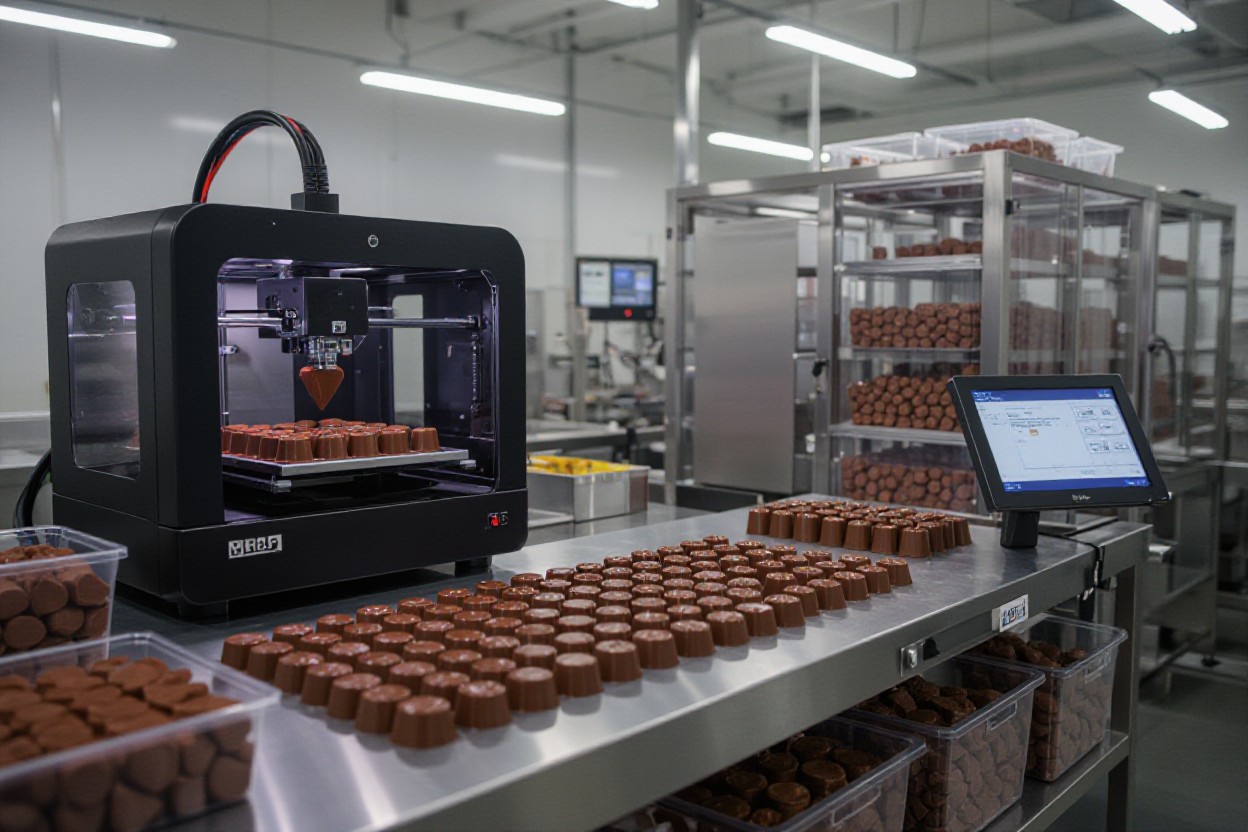
You need operator-centered features that lower cognitive load and speed up changeovers on chocolate manufacturing machinery; intuitive layouts, clear maintenance access panels, and standardized module footprints let you swap enrobing, tempering or molding units in minutes. Studies of modular lines show uptime improvements of 10–20% when machines are designed for quick service, and integrating standardized spare parts reduces inventory SKUs across your fleet of chocolate manufacturing machinery.
Ergonomics in Machine Design
You benefit from height-adjustable platforms, slide-out workstations and anti-vibration grips that keep cycle times steady and reduce musculoskeletal strain on shift teams; ergonomic upgrades on chocolate manufacturing machinery have been linked to lower lost-time injuries and faster line pace. For example, retrofitting lift-assist conveyors and reachable service points often cuts routine maintenance time by one-third while improving operator satisfaction.
Simplified Interfaces and Controls
You want HMIs that guide tasks with step-by-step recipes, color-coded alarms and role-based menus so less-experienced staff can run complex chocolate manufacturing machinery reliably; pilots using simplified interfaces report setup time drops of up to 50% and fewer recipe-entry errors. Integrating MES/SCADA recipes via OPC UA lets you push validated parameters directly to machines, reducing manual entry.
Beyond basic touches, streamlined interfaces use contextual help, animated maintenance prompts and offline mobile tablets for line-side diagnostics so you can troubleshoot without stopping the line. Remote expert access and embedded analytics let your technicians view sensor trends and fault histories on chocolate manufacturing machinery in real time, accelerating mean time to repair and preserving product consistency across shifts.
Training and Skill Development for Staff
You should adopt blended programs combining microlearning, hands-on modules and competency checklists so operators achieve proficiency faster on new chocolate manufacturing machinery; many manufacturers pair 1–2 hour micro-lessons with supervised practice to standardize performance. Tracking skills in an LMS lets you map gaps and assign targeted refreshers aligned to specific machine models.
To deepen capability, deploy VR simulators for start-up sequences and fault scenarios, plus a sandbox machine for live practice; this approach reduces classroom hours on the line and shortens time-to-certification. When you log operator performance metrics against recipes and downtime, your training becomes data-driven and directly improves OEE across chocolate manufacturing machinery.
Regulatory Compliance and Food Safety
You must align chocolate manufacturing machinery with global standards like FDA FSMA, EU Regulation (EC) No 178/2002 and ISO 22000 while implementing HACCP plans; manufacturers increasingly combine AI-driven sensors and traditional CIP systems to meet inspection thresholds. See how automation ties into compliance in Enhancing Chocolate Manufacturing: The Role of AI and … to benchmark approaches for traceability and sanitation audits using your production data.
Adapting Machinery to Meet Regulations
When you retrofit chocolate manufacturing machinery, specify food-grade 316 stainless surfaces, IP69K-rated motors and FDA- or EU-approved contact materials to pass inspections; automated clean-in-place cycles, validated by microbial swabs, reduce downtime and help meet regulatory sampling frequencies—typically daily surface checks and weekly product tests in high-risk lines.
Quality Assurance Practices
You should integrate inline inspection tools—X-ray, metal detection to 2.5 mm sensitivity, and machine-vision classifiers—into chocolate manufacturing machinery to catch foreign objects and visual defects before packaging, enabling real-time rejection and logging for audits.
Beyond sensors, implement statistical process control (SPC) dashboards that log tempering curves, viscosity, and cooling tunnel profiles at 1 Hz; this allows you to correlate 0.5°C deviations with bloom risk and maintain water activity targets (e.g., aw <0.6) and shelf-life claims, supporting corrective action records for auditors.
Traceability and Transparency in Production
You can add serialization and batch coding modules to chocolate manufacturing machinery so every bar carries a GS1-compliant code or QR linking back to production metadata; this supports faster recalls and consumer-facing provenance that regulators and retailers increasingly demand.
For deeper traceability, couple your PLC/SCADA logs with cloud ledgers or blockchain pilots that record supplier lot IDs, roast profiles and packaging timestamps; pilot results show batch lookup times dropping from days to hours, and you gain audit trails that map raw cocoa lots through every processing step in your line.
Future Trends in Chocolate Machinery
Predictions for Next-Gen Technology
You’ll see AI orchestration and additive manufacturing converge: AI-driven process control and vision systems will cut rejects and variability, while industrial 3D chocolate printers reach throughputs of hundreds of pieces per hour for complex geometries. Expect modular chocolate manufacturing machinery you can reconfigure in days, robotics with sub-5‑second deposition cycles for enrobing lines, and edge-AI enabling predictive maintenance that can reduce unplanned downtime by up to 30% on pilot lines.
Predictions for Next-Gen Technology — Additional Detail
Manufacturers already testing digital twins let you simulate line changes before hardware investment, lowering retrofit costs by an estimated 20%. Open protocols will let legacy chocolate manufacturing machinery accept plug-and-play sensors, and you’ll find small-batch intelligent cells—combining 3D printers, temperers, and vision—delivering bespoke runs without sacrificing yield.
The Impact of Consumer Preferences
You’ll need machinery that supports traceability, low-waste customization, and alternative ingredients: multi-ingredient hoppers and gentle mixing modules make plant-based ganaches feasible on the same line, while batch-trace embedding lets chocolate manufacturing machinery log origin data per SKU to meet shopper demands for provenance.
The Impact of Consumer Preferences — More Info
As personalization grows, you can deploy inline flavor dosing and SKU-on-demand cells to produce thousands of unique permutations; pilot projects showed personalized runs reduce inventory by over 40%. You’ll also adapt chocolate manufacturing machinery for cleaner labels and single-origin production, using segregated lines or rapid-clean quick-change manifolds to switch recipes in under 30 minutes.
Philosophical Changes in Chocolate Manufacturing
You’ll notice a shift from scale-first to purpose-first production: micro-factories and decentralized lines let brands prioritize ethical sourcing and freshness, forcing chocolate manufacturing machinery to be compact, energy-efficient, and audit-ready while maintaining industrial-grade throughput when needed.
Philosophical Changes in Chocolate Manufacturing — More Info
Operational philosophy will prioritize circularity and transparency, so you’ll choose temperers and refractometers with lower energy footprints and integrated CO2 tracking; some tempering technologies can lower energy use by roughly 15–20%. This mindset drives procurement toward machines designed for longevity, field-upgradable control stacks, and documented supply chains embedded into chocolate manufacturing machinery firmware.
Case Studies of Success
You’ll see tangible returns when chocolate manufacturing machinery is deployed with clear KPIs: one plant cut scrap 18% while raising throughput 27%, and another artisanal producer scaled bespoke orders 5x using desktop 3D printers. These case studies show how you can translate advanced machinery into ROI, shorter lead times, and measurable quality gains across tempering, enrobing, and packaging lines.
- Case 1 — Global chocolatier (2023): implemented AI-driven line orchestration + upgraded tempering modules; throughput rose from 4.0 to 5.1 t/day (+27.5%), OEE improved 62% → 78%, scrap down 18%, CAPEX $2.4M, payback 11 months.
- Case 2 — Artisan co-packer: integrated six desktop 3D chocolate printers for customization; custom-piece output 1,200/week, molding labor cut 60%, lead time 5 days → 1 day, initial investment $48k, margin on bespoke SKUs +35%.
- Case 3 — Mid-size factory: deployed machine-vision inspection and barcode tracking; defect rejection 1.6% → 0.25%, throughput +14%, annual quality savings ~$420k, traceability resolution time reduced from 72h to under 2h.
- Case 4 — Bean-to-bar startup: automated roasting with AI roast profiles and inline moisture control; yield 62% → 68%, energy per kg −12%, time-to-market halved, CAPEX $320k, break-even in 16 months.
- Case 5 — Co-packer with cobots: collaborative robots on enrobing/packing lines; FTEs per shift 8 → 3, line throughput +34%, OEE +19%, ROI achieved in 9 months, downtime frequency halved.
Highlighting Innovative Companies
You can look to a mix of incumbents and startups for templates: large manufacturers scale AI orchestration across multiple plants, while niche firms adopt 3D printing to monetize personalization. Vendors that pair service contracts with machine upgrades let you evolve chocolate manufacturing machinery incrementally, reducing disruption while proving value on pilot lines.
Lessons Learned from Implementation
You’ll find that phased rollouts, cross-functional teams, and real-world pilots mitigate risk: many sites report 4–9 months to stabilize new systems and 6–12 weeks for operator upskilling. Aligning OT and IT early prevents data silos and accelerates measurable gains from chocolate manufacturing machinery.
More detail shows you should pilot on a single SKU and collect at least 8–12 weeks of baseline data before tuning AI models; integration projects commonly spend 15–25% of total budget on systems integration and validation. Expect iterative tuning—initial yield improvements of 10–25% often require another 6–12 months to mature into consistent 20–35% gains across product families.
Achievements in Production Efficiency
You’ll notice sustained efficiency uplifts when chocolate manufacturing machinery is optimized: OEE jumps of 15–25%, throughput increases of 20–35%, and waste reductions of 10–20% are typical across tempering, molding, and enrobing upgrades. Those improvements translate to faster fulfillment and higher margins.
Further analysis reveals energy savings per ton of finished chocolate often fall 8–15% after process automation and smart scheduling. With line balancing and predictive maintenance, you can reduce unplanned downtime by 40–60%, shorten changeover times 30–50%, and push payback windows under 12–18 months for well-executed projects in chocolate manufacturing machinery.
Conclusion
The advances in chocolate manufacturing machinery have transformed how you design, produce, and scale confections; chocolate manufacturing machinery now integrates 3D printing for customization and AI automation for process control. As an operator, you can use chocolate manufacturing machinery to reduce waste, improve consistency, and expand product lines. Your investment in chocolate manufacturing machinery and in training will let you harness data-driven efficiency, and your oversight will ensure chocolate manufacturing machinery meets quality standards.