Table of Contents
- Understanding Food Packaging Regulations
- Differing Labeling Requirements
- Packaging Material Regulations
- Weight, Measure, and Language Laws
- Allergen Labeling and Claims
- Documentation and Certifications
- Case-by-Case Regulatory Differences
- The Role of Compliance Experts
- Practical Steps for Ensuring Compliance
- Common Pitfalls in Exporting Food Products
- Understanding Market-Specific Challenges
- Best Practices for Exporting Food Products
- Case Studies of Successful Compliance
- To wrap up
With expanding international trade, you must navigate food packaging regulations export to align labels, safety, and documentation with destination rules. Understanding food packaging regulations export lets you choose compliant materials and label claims, and tracking hygiene and tests meets inspection standards. Consulting experts on food packaging regulations export reduces rejection risk, while integrated quality systems and traceability based on food packaging regulations export protect your brand and market access under food packaging regulations export.
Understanding Food Packaging Regulations
When exporting, you must assess material composition, migration limits, labeling and traceability to meet food packaging regulations export. Examples include specific migration testing for monomers and additives, shelf-life validation protocols and allergen labeling alignment. You should assemble technical files with Certificates of Analysis, migration reports and supplier declarations so customs and buyers can clear consignments efficiently.
Overview of Global Standards
Codex Alimentarius sets international benchmarks, the EU enforces Regulation (EC) No 1935/2004 and Commission Regulation (EU) No 10/2011 for plastics, and the U.S. follows FDA 21 CFR parts 174–190. You can map your QA to ISO 22000 and national GB standards for China to reduce rejections under food packaging regulations export.
Importance of Compliance
Non-compliance leads to detained shipments, recalls and commercial penalties that harm margins and reputation; you may face refusal of admission under U.S. law or Rapid Alert notifications from the EU. In tangible terms, a single rejected container can cost tens of thousands in logistics, disposal and lost contracts while undermining trust in your offering of food packaging regulations export.
Practical mitigation means you should maintain current Declarations of Conformity, migration test reports and documented supply‑chain controls; for instance, EU Specific Migration Limits (SMLs) often require third‑party lab certification under Regulation (EU) No 10/2011. You will cut border delays and insurance disputes when you present market-specific documentation aligned with food packaging regulations export requirements.
Key Regulatory Bodies
Regulatory oversight spans EFSA and the European Commission, the U.S. FDA, Codex Alimentarius (FAO/WHO), China’s National Health Commission and national ministries of agriculture or health. You should monitor guidance, notified bodies and national enforcement updates to interpret requirements and pre-certify packaging under food packaging regulations export frameworks.
Specifically, EFSA issues risk assessments that shape EU rules, the European Commission drafts binding regulations, FDA enforces 21 CFR at U.S. ports, and Codex standards underpin WTO SPS dispute resolutions; understanding each body’s enforcement mechanisms helps you prioritize testing, labeling and documentation to meet target‑market food packaging regulations export expectations.
Differing Labeling Requirements
You face a patchwork of rules across markets: some demand specific languages, allergen prominence, nutrition panels, net quantity, and origin statements, while others emphasize recycling marks and traceability. For instance, the EU requires standardized nutrition info and allergen emphasis, China enforces GB national standards and Chinese-language labels, and the U.S. has distinct Nutrition Facts formatting—these distinctions directly influence your timelines and artwork for food packaging regulations export.
European Union Labeling Laws
Under Regulation (EU) No 1169/2011 you must show allergens in a contrasting font, provide nutrition declarations per 100 g and often per portion, and display mandatory information in the member state’s official language(s). Country-of-origin labeling applies to fresh meat and certain single-ingredient foods, and EFSA-approved health claims are the only permitted claims; these specifications should drive your template choices for food packaging regulations export.
U.S. Food and Drug Administration Standards
The FDA requires the Nutrition Facts panel, serving sizes based on consumption, and FALCPA allergen declarations for the top eight allergens; the 2016 final rule added “Added Sugars” and updated serving sizes and format. You must meet font-size, layout, and nutrient declaration rules, so plan label proofs and supplier data collection early to avoid setbacks in your food packaging regulations export.
Compliance deadlines were Jan 1, 2020 for large manufacturers and Jan 1, 2021 for most smaller firms, with some extensions for limited cases; mandatory entries now include Vitamin D and potassium, plus % Daily Value based on a 2,000-calorie diet. You should verify ingredient common names, test mock-ups against FDA guidance, and maintain records for inspections to prevent rework or detention of your food packaging regulations export shipments.
Other Countries’ Unique Labeling Regulations
Japan mandates Japanese-language labeling and specific nutrient declarations; China enforces GB standards and often requires Chinese-language ingredient names; Brazil’s ANVISA demands Portuguese and a standardized nutrition table; Gulf states require Arabic labeling. These variations will dictate your translations, proofs, and certification paths when planning your food packaging regulations export strategy.
In practice, Australia’s Country of Origin Labelling needs a text statement or bar-chart for percentages, while the UK has retained EU-style allergen prominence post-Brexit but adds new trade markings for non-EU imports. You should allow extra lead time for translations, legal attestations, and conformity testing to avoid delays or refusals of your food packaging regulations export consignments.
Packaging Material Regulations
You must assess materials for migration, durability, and compatibility with your product to comply with food packaging regulations export; selection affects shelf life, liability, and customs clearance. Use documented testing and a Declaration of Compliance to show compliance with food packaging regulations export, and factor in country-specific limits for recycled content, NIAS evaluation, and labeling so audits and inspections go smoothly under food packaging regulations export.
Food-Safe Materials Overview
Plastics (PET, HDPE, PP), glass, aluminum, and coated paper dominate food-contact use; you should test for overall migration and specific migrants using EU/ISO simulants like 3% acetic acid and 10% ethanol under standard conditions (e.g., 10 days at 40°C) to meet food packaging regulations export requirements, and document compatibility with pH, fat content, and temperature of your intended foods.
EU Regulations on Packaging
Regulation (EC) No 1935/2004 and Commission Regulation (EU) No 10/2011 (plastics) set the framework: an overall migration limit (OML) of 10 mg/dm² for many materials, substance-specific migration limits (SMLs), and obligations to assess NIAS; you must issue a Declaration of Compliance and retain technical documentation when targeting EU markets under food packaging regulations export.
For example, BPA restrictions, the recycled-plastics rules under Regulation (EC) No 282/2008, and explicit lists of authorized monomers require you to validate recycling processes and confirm traceability; testing often combines migration analysis, GC-MS screening for NIAS, and supply-chain audits so your products meet EU audit checks relevant to food packaging regulations export.
U.S. Regulations for Food-Contact Substances
FDA oversight relies on 21 CFR parts 174–179 and specific polymer listings (e.g., 21 CFR 177.1520 for olefin polymers); you can market materials that are covered by an existing regulation, an effective Food Contact Notification (FCN), or a No Objection Letter, and you should keep formulation records and migration data to support compliance with U.S. requirements when exporting under food packaging regulations export.
Practically, adhesives (21 CFR 175.105), coatings, and polymer additives must match approved specifications or be cleared via an FCN; you may also use established test methods (e.g., FDA extractives/migration protocols) and coordinate with FDA reviewers or accredited labs to resolve questions that impact your timelines and acceptance under food packaging regulations export.
Weight, Measure, and Language Laws
Formatting Requirements for Net Weight
You must present net weight clearly on the principal display panel; many export markets require metric units (g/kg) while the U.S. uses ounces/pounds, so include both when selling across borders—for example “500 g (1.1 lb)”. EU rules set a minimum x‑height of 1.2 mm for mandatory particulars, and some national rules demand a specific placement and font contrast, so check both EU and FDA/CFIA specs when preparing labels for food packaging regulations export.
Date Format Variations by Region
Ambiguous dates are a common compliance snag: the U.S. favors MM-DD-YYYY, much of Europe uses DD-MM-YYYY, and ISO 8601 (YYYY-MM-DD) is increasingly preferred to avoid confusion—03/04/2025 can represent March 4 or April 3. You should standardize date format for each destination and explicitly label the date type (e.g., “Best before: 2025-04-03”) to meet food packaging regulations export requirements and prevent hold-ups at customs.
Beyond format, date type labeling differs by jurisdiction and affects legal obligations: the EU distinguishes “date of minimum durability” (best before) from “use by” for safety — the latter applies to highly perishable items. The U.S. generally leaves date marking to manufacturers except for infant formula, while many Asian markets accept ISO 8601. You should map which date label and format each target market demands to align your shelf‑life claims with food packaging regulations export.
Language and Bilingual Labeling Needs
You’ll face strict language rules in several markets: Canada mandates bilingual English/French for prepackaged foods and Quebec’s Bill 101 requires French predominance, while the EU expects mandatory particulars in the official language(s) of the member state of sale. Exporters to China, Japan, or Middle Eastern countries must supply translations in local scripts. Plan translations for ingredients, allergens, and nutritional claims to comply with food packaging regulations export and avoid market rejections.
In practice, you should adopt a language strategy that covers order, prominence, and legal terms: Quebec requires French to be at least as prominent as English; Belgium’s language requirements change by region (Dutch in Flanders, French in Wallonia). Use certified translators, back‑translation for allergens and claims, and maintain identical ingredient sequencing to meet inspections and documentation checks tied to food packaging regulations export.
Allergen Labeling and Claims
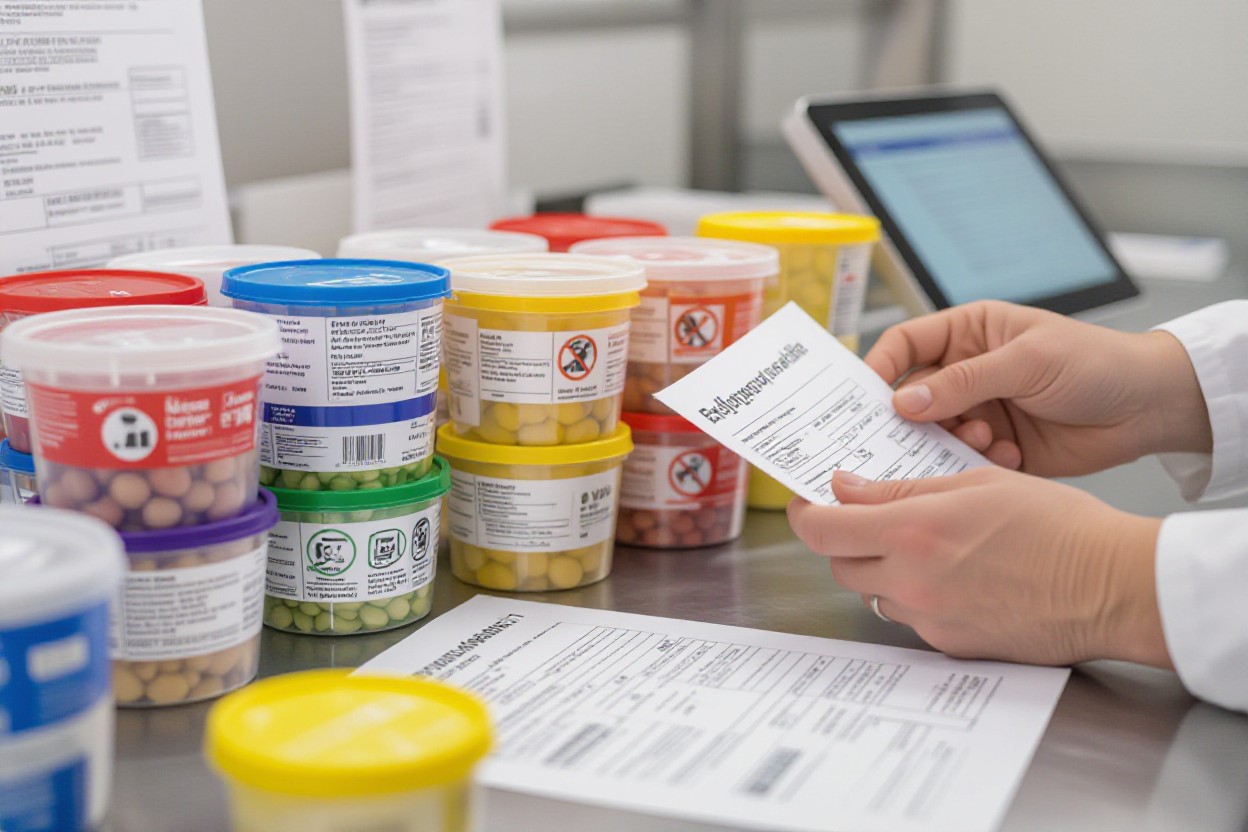
You must explicitly declare priority allergens and any advisory statements that affect import clearance, since regulators screen labels under food packaging regulations export standards. In practice, you’ll emphasize allergens in the ingredient list, ensure translations match local terminology, and update packaging promptly after formulation changes to avoid border holds or misbranding penalties.
Allergen Labeling Requirements
You need to follow destination-specific lists: the EU requires declaration of 14 allergens (e.g., gluten cereals, milk, nuts, sesame), while the US FALCPA lists nine major allergens (including sesame since 2023). Legibility matters: the EU mandates a minimum font size (1.2 mm) and clear emphasis on allergens, and you must align your labels with each market’s food packaging regulations export expectations.
Health Claims and Nutritional Information
You must use only authorized health claims and accurate nutrition panels—EU claims need prior EFSA authorization under Regulation 1924/2006, and the US limits health and nutrient content claims under FDA rules. Also, you’ll provide nutrition declarations per 100 g/ml in the EU versus per serving and per container in the US, so adapt your layout when complying with food packaging regulations export rules.
You should validate quantitative thresholds before claiming terms like “source of fiber” (EU: ≥3 g/100 g) or “high fiber” (EU: ≥6 g/100 g), while the US uses percent Daily Value per serving (10–19% DV = good source; ≥20% DV = high). For cross-border exports your formulations, analytical reports, and claim support dossiers must align with local legal definitions to satisfy food packaging regulations export audits.
Consequences of Non-compliance
You face immediate commercial and legal risks: customs can detain or reject shipments, importers may be fined, and mislabeling can trigger recalls or civil liability. Market-specific enforcement varies, but non-compliance with food packaging regulations export often leads to shipment delays, returned consignments, and damage to buyer relationships.
You should expect regulator actions such as FDA import alerts, EU competent authority notifications, and seizure or destruction of non-compliant goods; downstream costs include recall logistics, legal defense, and lost sales that can escalate quickly. Documented compliance and a rapid corrective action plan reduce enforcement exposure and help restore market access.
Documentation and Certifications
You should compile a complete export dossier—commercial invoice, packing list, HS codes, certificates and any buyer-specific forms—so customs can clear shipments quickly; consult standards like Food Label Requirements and Compliance for label alignment. Ensuring each document references your product’s specifications reduces detention risk, and tight coordination with your freight forwarder keeps you aligned with food packaging regulations export and importer requirements.
Certificates of Origin and Trade Agreements
You must supply the correct certificate of origin when claiming tariff preferences—Form A, EUR.1, or origin declarations under USMCA—so your buyer can access reduced duties. Align HS codes and supplier declarations, since mismatches are a common cause of penalties; proactive verification helps you meet customs rules tied to food packaging regulations export without delaying shipments.
Health and Sanitary Certificates
You need health and sanitary certificates endorsed by your competent authority for animal, plant and processed foods, with species, treatment and establishment IDs clearly listed. Missing or unsigned certificates frequently trigger rejections at ports, so coordinate veterinary or phytosanitary inspections early to avoid hold-ups under food packaging regulations export regimes.
For more detail, exporters to the EU must use prescribed model certificates in Commission Implementing Regulations, while China (GACC) and other markets enforce strict labelling of processing steps and residue limits; you should track country-specific annexes, electronic submission portals and retention periods to prevent non-compliance and shipment denial.
Quality Certifications and Compliance
You should obtain scheme certifications buyers expect—HACCP, ISO 22000, BRCGS, FSSC 22000, GlobalG.A.P., organic, Kosher or Halal—to demonstrate process control and traceability. Many retailers require these for listings, so securing audits and certificates reduces onboarding time and supports your claims under food packaging regulations export during due diligence checks.
In practice, completing a GFSI-benchmarked audit often shortens retailer approval from months to weeks; maintain corrective action records and certification scope documentation, and ensure your certification bodies are accredited (e.g., UKAS/ANAB) so your quality credentials are accepted across jurisdictions tied to food packaging regulations export.
Case-by-Case Regulatory Differences
You encounter wide variation across markets where food packaging regulations export hinge on language, labeling, waste schemes, and import notifications; for example, a product that meets EU materials rules can still fail in the Middle East for missing Arabic labels, while U.S. shipments may be held for prior notice errors, so you must map requirements market-by-market to avoid delays.
Middle Eastern Label Content Restrictions
You must provide Arabic-language labels in many Gulf states, with Saudi Arabia’s SFDA often demanding ingredient lists, allergen declarations, net weight, manufacturer and country of origin in Arabic; halal certification is commonly required for meats and many dairy products, and incorrect date formats or missing storage instructions frequently trigger rejections under regional food packaging regulations export.
EU Packaging Waste Regulations
You face Extended Producer Responsibility across the EU, where member states use national schemes and fees tied to material and weight; Germany enforces the VerpackG with mandatory LUCID registration before you place packaged goods on the market, so plan for registration, reporting, and fees when complying with food packaging regulations export.
You should expect EPR fees to vary: lightweight plastic bottles often attract lower per-unit fees than multi-material composite cartons, and reporting cycles are usually quarterly or annual; for instance, exporting 20,000 single-use containers to France will trigger producer registration, tonnage reporting, and fee invoices under EU packaging waste rules for food packaging regulations export.
U.S. FDA Prior Notice Requirements
You must submit electronic Prior Notice to the FDA before an imported food arrives, including product identity, shipper, consignee, manufacturer, country of origin and anticipated arrival; carriers and importers who fail to provide timely prior notice face refusal, detention, and potential re-export under U.S. food packaging regulations export enforcement.
You will file Prior Notice via the FDA’s system or through your customs broker and receive a confirmation number that accompanies the shipment; for example, sending 10 pallets of canned tomatoes to New York without that confirmation commonly results in port holds and added storage or re-export costs, directly affecting your margins under food packaging regulations export.

The Role of Compliance Experts
Specialists in regulatory affairs, lab testing, and label review help you navigate food packaging regulations export by translating local statutes into actionable checklists for labeling, ingredient limits, and packaging materials. They routinely interact with agencies like FDA, EFSA, CFIA and FSANZ, identify required documents (e.g., certificates of analysis, nutrition profiles), and cut avoidable delays in import clearance and shelf-entry.
Importance of Expert Consultation
You should engage regulatory consultants and toxicologists to validate claims, review allergen matrices (the EU lists 14 priority allergens), and design stability studies; consultants also prepare dossiers for platform registrations. Their input reduces the risk of rejected shipments and streamlines compliance with food packaging regulations export by ensuring testing protocols and label language meet each jurisdiction’s specificity.
Working with Local Partners
Local importers, authorized representatives, and ISO 17025 labs provide jurisdictional know-how you can’t replicate remotely: many countries require a local agent for registration and shipments. Expect registration timelines commonly between 2–8 weeks and testing add-ons of 3–6 weeks; your partner handles translations, deposit of samples, and liaison with inspectors to keep your food packaging regulations export process moving.
Vet partners through reference checks, audit reports, and proof of previous clearances; require contractual SLAs, data access rights, and traceability protocols. Use local labs with ISO 17025 accreditation for chemistry and microbiology tests, request chain-of-custody documentation, and mandate quarterly performance reviews to ensure your food packaging regulations export requirements remain met.
Staying Updated on Regulatory Changes
You must subscribe to agency feeds (FDA, EFSA, CFIA), use paid regulatory intelligence tools, and monitor trade portals for amendments to permitted additives, labeling thresholds, or country-specific marking. Guidance and standards often change quarterly or annually; proactive monitoring prevents surprises and keeps your packaging, claims, and documentation aligned with current food packaging regulations export expectations.
Implement a formal update workflow: assign an owner to screen bulletin feeds weekly, summarize changes in a 30-day action plan, and route required label or formulation changes through a change-control board. Maintain versioned label archives and update your supplier contracts to reflect new requirements to sustain continuous compliance with food packaging regulations export.

Practical Steps for Ensuring Compliance
Map requirements by destination—language, nutrition panels, lot codes, allergen declarations, and permitted claims—then embed those items into procurement, packaging, and QA workflows. You should use official sources and standards (e.g., Reg (EU) No 1169/2011, FDA guidance, NMPA notices) to drive SKU-level changes. Treat food packaging regulations export as a product-spec constraint to cut delays, lower rejection rates, and maintain traceability across batches.
Conducting Market Research
Start with a market matrix listing EU, US, China, Japan, Mexico and identify the specific label elements for each: language, units (metric vs. US customary), allergen declarations (9 major allergens in many jurisdictions), and claim rules. You should consult EFSA/FDA/NMPA databases, importers’ requirements, and recent enforcement actions; using this data makes food packaging regulations export decisions based on evidence rather than assumption.
Creating a Compliance Checklist
Draft a checklist that breaks down requirements per market: ingredient list, nutrition panel format, mandated statements, country-specific claims, storage and shelf-life markings, and required certificates (organic, halal, etc.). Assign an owner, due dates, verification steps, and link each line to the exact regulation so your team can act quickly when food packaging regulations export demands change.
Expand the checklist into a living spreadsheet with columns for SKU, destination, required elements, status (draft/approved/printed), evidence (certificates, lab reports), owner, and next review date. You should require 100% label sign-off for new SKUs and template changes, then move to risk-based sampling (for example, 10% of lots) for ongoing production. Integrate third-party lab results, version control for artwork PDFs, and a change-log noting why each alteration was made to reduce errors during food packaging regulations export.
Regularly Reviewing Packaging and Labels
Schedule periodic reviews—quarterly for stable markets, immediately after regulatory updates or product reformulations—to verify translations, barcodes, nutrition calculations, and allergen statements. You should run pre-shipment audits, update master artwork files, and track deviations so food packaging regulations export stays compliant and shipments clear customs without costly returns or rework.
Implement a review workflow: 100% inspection of first production runs, then random audits covering at least 10% of batches. You should track KPIs such as percent label errors per quarter (target under 2%) and time-to-correct. Use version-controlled master files, maintain a centralized translator list to avoid inconsistent terminology (e.g., “best before” vs. local equivalents), and engage accredited labs for country-specific testing to close gaps flagged during food packaging regulations export checks.
Common Pitfalls in Exporting Food Products
You can hit predictable snags that delay shipments and add costs, often tied to food packaging regulations export compliance: incorrect label language, unapproved packaging materials, and missing certificates frequently lead to rejections, returns, or fines and extra warehousing fees that can add thousands to a single container.
Labeling Errors
In food packaging regulations export matters, if you mislabel ingredients, allergens, or nutrition, customs or retailers may reject entire batches; EU FIC requires allergens highlighted and nutrition per 100g, while many markets insist on local-language labels and minimum font sizes—errors commonly cause 2–6 week holds and added translation or relabeling costs.
Packaging Non-compliance
Packaging failures often arise from ignoring food packaging regulations export on materials and testing: using inks, adhesives, or recycled plastics without a Declaration of Compliance breaches EU 10/2011 and similar rules, and insufficient barrier properties compromise shelf life for vacuum-packed or refrigerated goods.
You should run overall and specific migration tests, plus sensory and shelf-life validation; typical lab testing costs range $300–$2,000 per SKU with 2–4 week lead times. For example, a UK importer once rejected canned sauce after phthalate migration exceeded limits, causing a six-week recall and $25,000 in losses—so verify supplier DoCs and test results align with food packaging regulations export before shipping.
Documentation Oversights
Missing or incorrect paperwork is a top cause of delays: incomplete Certificates of Analysis, absent sanitary or phytosanitary certificates, wrong Harmonized System codes, or missing country-of-origin declarations can trigger detentions; you must match invoice descriptions, net weight units, and food packaging regulations export documentation to destination customs.
Audit your export dossier with a checklist: CoA, DoC, health/sanitary certificates, commercial invoice, packing list, bill of lading, certificate of origin, and any export licences. Small mismatches—like grams versus kilograms or a missing signature—can cause customs holds and demurrage fees often $50–$200 per day, plus re-testing and corrective logistics.
Understanding Market-Specific Challenges
When you export, differing rules across regions force changes to packaging materials, languages, and declarations: the EU mandates 14 highlighted allergens and per‑100g nutrition info, Canada requires bilingual English/French labels and metric units, and China enforces Chinese-language labels and GB standards. Adapting SKU specs and artwork early reduces redesign cycles and compliance holds; tracking food packaging regulations export per market saves weeks and avoids costly rework when shipments hit customs.
Cultural Considerations in Labeling
You must match cultural norms on imagery, symbols, and claims: some Gulf states require Arabic plus halal certification marks, Israel needs kosher clarity, and Japan expects polite phrasing and precise ingredient order. Colors and icons can trigger misinterpretation—red can imply danger in parts of Asia—so testing labels with local focus groups or using local agents prevents rejections under food packaging regulations export rules.
Diverse Consumer Preferences
You need to tailor formats, portion sizes, and flavor profiles: North American markets favor larger pack sizes, Japan and South Korea prefer single‑serve or resealable small packs, and Latin American consumers often prefer bolder spice profiles. Aligning R&D and packaging choices with these preferences improves shelf penetration and reduces returns tied to mismatched expectations under food packaging regulations export.
Digging deeper, you should price and size SKUs to local buying patterns—trial or promo sizes ($1–$3) increase trial in crowded retail channels, while value packs boost penetration in price‑sensitive markets. For example, a UK snack exporter that added 30g single‑serve SKUs for Japan saw an 18% sales lift in six months. Integrating consumer insights into your packaging spec and labeling streamlines approvals and supports faster compliance with food packaging regulations export.
Economic Factors Affecting Compliance
You face direct costs and timing that affect market entry and ongoing exports: lab testing, registration, and translator fees add up and can vary widely across destinations.
- Lab testing: $200–$1,500 per SKU depending on assays
- Registration/certification: $500–$5,000 per market
- Tariffs: 0–30% depending on HS code and trade agreements
After you model these expenses against margins, you can decide whether to consolidate SKUs, split costs with distributors, or adjust retail pricing to maintain competitiveness under food packaging regulations export.
You should also plan for time‑to‑market impacts: some markets require 2–12 weeks for testing and 1–6 months for registration or label approval, which affects cash flow and inventory cycles. Mitigation steps include batch testing in accredited labs, using harmonized artwork templates, and leveraging local registrars.
- Expedite testing with accredited labs to cut lead time
- Use modular artwork to swap languages without redesign
- Negotiate distributor stockholding to buffer approvals
After assessing these levers, you can prioritize markets where the return justifies the compliance investment and align your supply chain to meet food packaging regulations export timelines.
Best Practices for Exporting Food Products
Map regulatory checklists by market, run pre-shipment label reviews against the Guidance for Industry: Food Labeling Guide January 2013, and maintain lot-level traceability with 7–10 year records where required; integrating these steps reduces rejections and aligns your operations with food packaging regulations export expectations across jurisdictions.
Quality Control during Packaging
Institute statistical sampling—1 sample per 5,000 units or per production lot—for label accuracy, perform seal integrity and metal-detection checks on every run, and document allergen-cleaning swabs; these controls limit contamination risks and demonstrate compliance during audits focused on food packaging regulations export.
Regular Training for Export Teams
Schedule quarterly training on labeling rules, customs paperwork, and destination-specific limits; run mock inspections and use checklists so your team spots missing nutrition panels, translator errors, or noncompliant claims before shipment, directly lowering nonconformances tied to food packaging regulations export.
Design a blended curriculum with e-learning modules, hands-on label-proofing sessions, and periodic assessments; track KPIs such as label-error rate and detention incidents—one supplier cut label rework by 60% after monthly refreshers—and certify staff to handle updates to food packaging regulations export.
Leveraging Technology for Compliance
Adopt label-management systems, GS1 barcode verification, and cloud-based traceability to auto-generate country-specific labels and certificates, reducing manual errors that trigger border holds and aligning electronic records with food packaging regulations export.
Integrate your ERP with a label-authoring platform and use rule-based templates to auto-populate translations, nutrition data, and allergen statements; pilot blockchain or serialized QR codes for batch verification—companies using these setups report 40–70% faster recalls and a 75% drop in label mismatches, improving adherence to food packaging regulations export standards.
Case Studies of Successful Compliance
You can learn from targeted interventions that reduced border delays and losses; these case studies highlight label harmonization, traceability upgrades and pre-shipment testing that met food packaging regulations export standards, lowering rejection rates and shortening clearance times so you can scale into new markets with fewer setbacks.
- 1) European dairy SME — After updating allergen declarations and font sizes to match EU rules, rejection rate fell 85% (from 20 to 3 rejects per 100 shipments), time-to-market dropped 12 days, and 12-month export revenue rose 18% while meeting food packaging regulations export requirements.
- 2) U.S. beverage exporter — Implemented electronic sanitary certificates and FDA preclearance: border holds decreased from 9% to 1.5%, average clearance time shortened from 7 to 1.5 days, and export volume grew 32% year-over-year.
- 3) Global snack brand — Adopted GS1 barcodes and batch-level traceability; recall simulation response time improved from 48 to 6 hours and inventory shrinkage declined 2.3%. See operational guidance in Navigating the Food Labelling World to align your processes with food packaging regulations export expectations.
- 4) Organic produce exporter to EU — Aligned certification and packaging across 27 member states, inspection flags dropped from 11% to 0.8%, and shelf-space wins increased by 25% after full compliance with food packaging regulations export norms.
- 5) Frozen foods to Asia — Standardized allergen and dual-language labels; shipment hold rate declined 78% and consecutive quarterly compliance audits returned 100% pass rates, demonstrating scalable compliance for food packaging regulations export.
Examples from the EU
You see strict mandates on language, nutrition panels and allergen order across member states; one exporter who translated labels into 24 languages and standardized nutrient reporting cut customs queries by 92% and matched food packaging regulations export expectations across all target markets.
Successful Strategies in the U.S.
In the U.S. you must align with FDA nutrition facts, allergen rules and state-level labels; firms that standardized templates, used accredited labs and filed prior notices reduced holds from about 6% to under 1% while meeting food packaging regulations export criteria.
Adopt centralized label controls, run pre-shipment label audits, and keep certificates of analysis on file to prevent state or federal objections. Operational changes you can deploy include automated label versioning, batch-level COAs, and a dedicated regulatory checklist; companies using this playbook trimmed average clearance time from six days to under two, cutting detention incidents by roughly 70%.
Lessons Learned from Non-Compliance
Non-compliance often stems from mistranslations, omitted allergen statements or inconsistent claims; one firm faced a $150k recall and six-month market suspension after failing to meet label and documentation requirements tied to food packaging regulations export standards.
Failure patterns show you need routine audits and third-party verification to avoid penalties. When you assess root causes, inconsistent supplier documentation and ad hoc labeling are common. Implementing supplier scorecards, random pre-shipment checks and harmonized label masters will markedly reduce hold rates—non-compliant shipments historically exhibit four times the detention risk compared with compliant ones under food packaging regulations export regimes.
To wrap up
Ultimately you must align labeling, safety, and documentation to succeed abroad; when you follow food packaging regulations export you protect consumers and shipments. By mapping standards, auditing processes, and training staff, you make compliance routine, and food packaging regulations export becomes part of your operations. Use testing, traceability, and clear labels so food packaging regulations export won’t delay customs. Ongoing monitoring keeps you current with food packaging regulations export and supports your reputation for compliance with food packaging regulations export.